科技
成均馆大学论坛探讨下一代太阳能电池的进展
中文译文
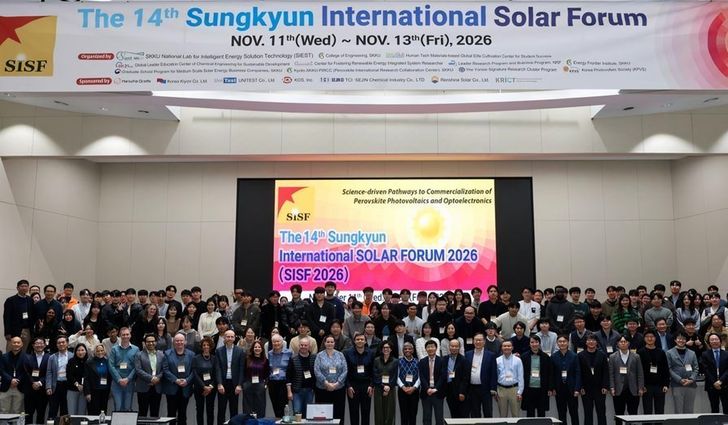
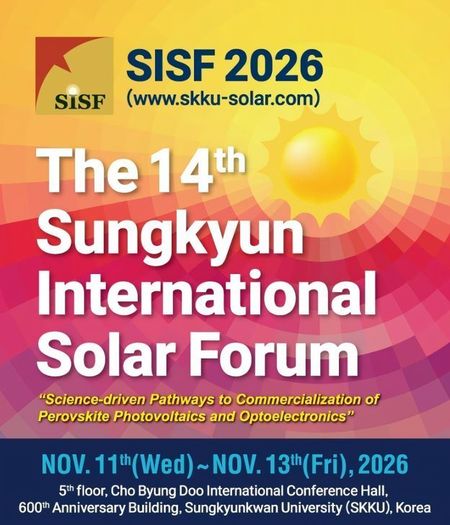
成均馆大学于11月11日至13日在首尔校区举办了第14届成均国际太阳能论坛,召集众多研究人员共同探讨钙钛矿太阳能电池及光电器件领域的最新进展。
随着人工智能数据中心的扩张以及电动汽车的日益普及,电力需求持续上升,与此同时,为应对气候危机,对无碳能源的需求也在不断增长。在此背景下,如何将被视为下一代发电技术的钙钛矿太阳能电池实现商业化,以及开发大规模生产的相关技术,已成为亟待解决的关键问题。
该校化学工程系杰出教授、SKKU智能能源解决方案技术国家实验室主任朴南圭担任了该论坛组织委员会的主席。他介绍了关于钙钛矿太阳能电池的最新研究成果,并概述了旨在推动其商业化的技术发展情况。
该大学表示,朴某是世界上首位研发出能够稳定长期运行的固态钙钛矿太阳能电池的研究人员,这为高效太阳能电池的研究奠定了基础。
此次论坛汇集了来自15个国家的约30位特邀演讲者,其中包括瑞士洛桑联邦理工学院的教授迈克尔·格拉策尔,以及美国圣母大学教授、ACS Energy Letters杂志的主编普拉尚特·V·卡马特。
其他演讲者还包括瑞典乌普萨拉大学的副校长安德斯·哈格费尔特、意大利佩鲁贾大学的教授菲利波·德安杰利斯、荷兰AMOLF研究机构混合太阳能电池小组的负责人布鲁诺·埃勒,以及韩华Qcells公司庞尤研发中心的负责人文秀珍。据该大学称,来自韩国及国外的研究人员和行业专家探讨了从材料性质的基础研究到器件开发及大规模生产各个阶段所面临的技术挑战。他们还研究了如何将研究成果转化为实际的工业应用。自2011年创办以来,该论坛已成为一个国际学术活动平台,旨在分享下一代太阳能电池的研究进展,并促进学术界与工业界的交流。该大学期望这些讨论能够推动更多国际研究合作以及产学协作,从而加速钙钛矿技术的商业化进程。
原文
Sungkyunkwan University hosted the 14th Sungkyun International Solar Forum at its Seoul campus from Nov. 11-13, bringing together researchers to discuss advances in perovskite solar cells and optoelectronic devices.
The forum came amid growing demand for carbon-free energy sources to address the climate crisis, as electricity demand continues to rise due to the expansion of artificial intelligence (AI) data centers and the increasing adoption of electric vehicles.
Commercializing perovskite solar cells, which are seen as a next-generation power generation technology, and developing technologies for mass production have emerged as key challenges.
Park Nam-gyu, a distinguished professor of chemical engineering at the university and director of the SKKU National Laboratory for Intelligent Energy Solution Technology, chaired the forum’s organizing committee.
He presented the latest research findings on perovskite solar cells and outlined technological developments aimed at their commercialization.
The university said Park was the first researcher in the world to develop solid-state perovskite solar cells capable of stable, long-term operation, laying the foundation for research into high-efficiency solar cells.
The forum brought together around 30 invited speakers from 15 countries, including Michael Grätzel, a professor at École Polytechnique Fédérale de Lausanne in Switzerland, and Prashant V. Kamat, a professor at the University of Notre Dame in the U.S. and editor-in-chief of ACS Energy Letters.
Other speakers included Anders Hagfeldt, vice-chancellor of Uppsala University in Sweden; Filippo De Angelis, a professor at the University of Perugia in Italy; Bruno Ehrler, director of the Hybrid Solar Cells group at AMOLF, a research institute in the Netherlands; and Moon Su-jin, head of the Pangyo R&D Center at Hanwha Qcells.
Researchers and industry experts from Korea and abroad discussed technological challenges at every stage, from fundamental research into material properties to device development and mass production, according to the university.
They also explored ways to translate research findings into practical industrial applications.
Since its launch in 2011, the forum has established itself as an international academic event for sharing research advances in next-generation solar cells and fostering exchanges between academia and industry.
The university expects the discussions to lead to expanded international research partnerships and industry-academia collaboration, helping accelerate the commercialization of perovskite technologies.