军事·安全
海地人对萨尔瓦多军队打击帮派感到兴奋,但同时也心存不安
中文译文
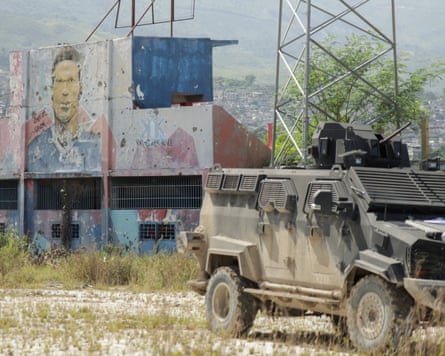
太子港主要足球场的围墙上,有一幅被子弹打满的海地前锋埃马纽埃尔·萨农的壁画。但已有两年多时间没有体育明星出现在这片球场上。
2024年,当周边城市几乎完全被武装团伙控制时,包括巴西的罗纳尔多和罗伯托·卡洛斯等足球巨星曾在此比赛的西尔维奥·卡托尔体育场也落入了犯罪分子的掌控之中,其破旧的红色和蓝色看台被一个名为伊佐的帮派头目的手下用作据点。海地国家队“石榴军”失去了主场,不得不在国外进行世界杯预选赛。
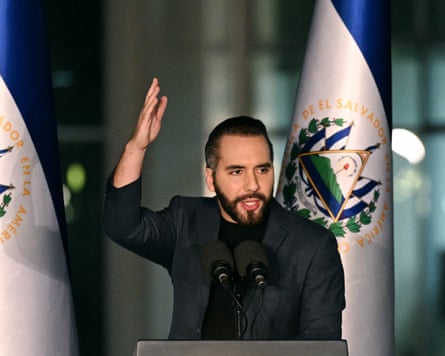
上周,随着海地警方和萨尔瓦多军队的重新占领,这一状况发生了变化。萨尔瓦多的专制总统纳伊布·布凯勒称这一进展是让海地摆脱犯罪叛乱的重要一步,这场叛乱已导致150多万人流离失所,数千人丧生。“现在我们在当地占据了优势,”布克勒宣称。自10月中旬以来,他已向海地派遣了2000多名士兵。
在以一位曾在1928年奥运会上获得银牌的著名海地运动员命名的西尔维奥·卡托体育场外,民众欢庆不已,他们希望这位外国政治家能成为一位意想不到的救星。
“一股希望之风正在我们国家吹拂,多亏了上帝,我们一定能渡过难关。布克勒万岁!”一位55岁的装饰师说道,他要求以博斯·巴顿为名。
站在萨农那幅饱经战火痕迹的壁画旁,巴顿回忆起2024年2月武装起义期间,罪犯放火烧毁了他的家园,他不得不离开名为波斯特-马尚的地区。“今天我们很高兴,因为有些地方以前我们无法前往,现在可以进去了——而能来到这里,全靠布克勒的介入,”巴顿说。近年来,在萨尔瓦多首都圣萨尔瓦多的街头也出现了类似的呼声,这源于布克勒具有争议的反帮派行动。该行动虽让数百万人摆脱了帮派的统治,但代价高昂。
自2022年初开始实施这项打击行动以来,已有超过9万名萨尔瓦多人被关押,这场大规模监禁行动虽然降低了谋杀率,但也引发了人们对于萨尔瓦多民主制度已走向终结的担忧。
布克勒在国内的严厉措施使他成为拉丁美洲和加勒比地区右翼政客及选民的宠儿,他们将他的行动视为证据,证明通过铁腕手段以及灵活的人权处理方式,可以控制猖獗的犯罪活动。
如今,布克勒希望在2月的选举中延长其为期七年的总统任期,他正试图在海外进一步彰显自己在打击帮派方面的功绩。“这是一次展示力量的行动,旨在将布克勒塑造为救世主的形象……同时让萨尔瓦多成为该地区在应对帮派问题及保障安全方面的重要典范,”武装冲突地点与事件数据项目中的拉丁美洲区域专家蒂齐亚诺·布雷达说道。
布克勒在海地的野心究竟有多大尚不清楚。此次行动的导火索是10月18日四名在联合国支持的安全部队工作的萨尔瓦多航空技术员遭绑架。周一,布克勒的副总统费利克斯·乌洛亚宣布,一旦这四名人员获救,萨尔瓦多军队就会立即撤出,“因为我们不是占领军——我们并非要长期驻留那里”。
不过乌洛亚也表示,其政府是出于“对海地人民和政府求助的回应”而采取行动,这暗示该行动的任务可能会延长。布克勒还暗示,他的计划不仅限于开展短暂的地面行动以解救本国公民或找回他们的遗体。“我们必将胜利。上帝会赐予我们胜利,”这位政治家本周如此宣誓。
许多海地人希望他的战斗人员能留下来,而且对布克勒在社交媒体上发布的视频感到十分振奋,这些视频展示了直升机对犯罪团伙据点以及一名被称为“塔利班”的歹徒豪宅的打击。
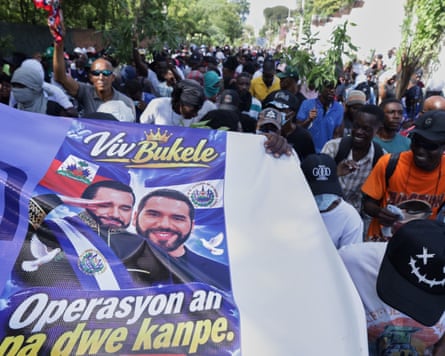
太子港各地的横幅和广告牌将布克勒誉为21世纪的解放者,上面写着“那些强盗休想安睡!”以及“我们累了!把布克勒交给我们!”之类的口号。
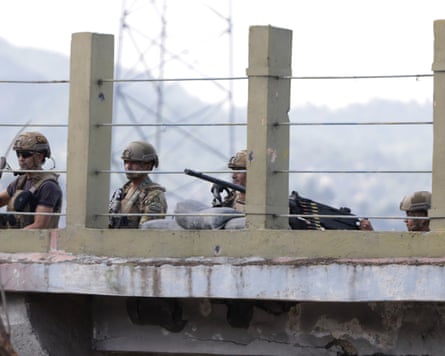
站在已被解放的足球场外,砖匠维内尔·桑多尔回忆起三年前罪犯在卡雷富尔-费耶斯烧毁他家的事情。“我无法进入我的社区,因为那些小偷还在那里。他们向我们开枪,”这位56岁的男子说着,掀起衬衫,露出右乳头上方的一处枪伤疤痕。“我们需要布克勒帮助我们回到家中,”赛因多尔说道。此时,一名萨尔瓦多士兵正持着带弹链的重机枪在体育场看台上警戒。
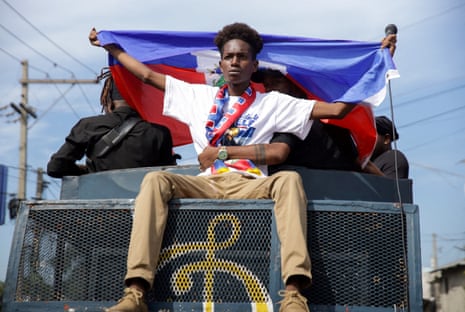
作家兼活动家莫妮克·克莱斯卡也表达了与那名砌砖工相同的热情。“海地人非常高兴……我也很高兴……这是充满希望的时刻,”她在周二表示。当时,成千上万的示威者涌上街头,支持布克勒,高呼“布克勒万岁!”以及“布克勒不是在开玩笑!”
当示威人群向总理办公室涌去时,各行各业的人都在讲述武装团伙如何毁掉了他们的生活,以及他们对布克勒能够带来解决方案的期盼。
“我以前开一辆旧巴士。那些强盗烧毁了它,还烧了我的房子,”50岁的司机威尔内·佩尔索纳说道,并补充说:“我们一直在等待布克勒……因为我们再也无法忍受这种状况了。”一名名叫克劳迪·马亚斯的食品摊贩呼吁“布克勒总统”坚持立场。“布克勒,我祝福你、你的妻子和你的孩子们,”51岁的马亚斯说道,“海地人民与你们同在,就如同你们与我们同在一样。”
克莱斯卡将这种明显的兴奋情绪归因于一种普遍的看法,即布克勒的“果断”行动揭露了海地及外国领导人的无能、低效与冷漠。“从根本上说,布克勒所做的是表明,领导力就是要为民众解决问题,”她说道,同时赞扬了体育场及其他地区在不到一个月内被夺回的成果。在一片兴奋之中,也存在着不安。一些人担心布克勒的军事行动会加剧海地首都及其周边本已动荡的局势,该地区很大程度上已如同战区一般。本周,在伊索的主要据点——上帝村,萨尔瓦多军队、警察与帮派之间发生了激烈战斗。周四,警方称在体育场附近的一次行动中,警察至少击毙了34名涉嫌犯罪的人。
一些人怀疑,这位在X平台和TikTok上拥有2200万粉丝、擅长运用社交媒体的萨尔瓦多总统,可能在网络宣传团队和粉丝的帮助下,夸大了其军队在近期取得的胜利中所起的作用。“纳伊布·布克勒是帮派的克星,”一位美国粉丝本周如此赞叹,称他的干预“堪称奇迹”。还有人担心布克勒无法区分帮派成员与平民,因为在萨尔瓦多,他发动的大规模拘留行动毫无差别,数千名无辜民众在未经正当法律程序的情况下被关押。
克莱斯卡对布克勒的镇压行动对萨尔瓦多民主与法治造成的破坏表示轻视,该国目前的人均监禁率位居世界首位。她认为,海地的政治已被有组织犯罪严重渗透,“简直就像黑手党掌控了唐宁街10号”。
“如果谈到对民主的侵犯,海地……几乎可以作为一个案例研究,其情况甚至比萨尔瓦多更糟糕、更明目张胆,”克莱斯卡说道。安全形势极为严峻,亟需采取紧急行动。“说实话……在海地,我们正遭受残酷对待,”克莱斯卡说道,“女孩们被当作性奴隶,遭到集体强奸。所以,在某个时刻,我们必须说:‘海地曾帮助过[南美独立英雄]西蒙·玻利瓦尔[他在19世纪初得到了海地的庇护和支持]……现在,布克勒也在帮助我们。’”
在周二的集会上,抗议者们用神圣的言辞来形容萨尔瓦多总统。“今天,我们将布克勒视为救世主,视为上帝派来的人,”一名男子说道,但他也提出了警告,提及了过去无数次干预最终都以失望和失败告终的例子。
“我有句话要对布克勒总统说,”他说道,“他绝不能开始帮助我们,却半途而废。”
原文
A bullet-peppered mural of the Haitian striker Emmanuel Sanon covers the facade of Port-au-Prince’s main football ground. But more than two years have passed since any sports stars graced the pitch.
In 2024, as the surrounding city was almost entirely captured by heavily armed gangs, Sylvio Cator stadium – where football greats including Brazil’s Ronaldo and Roberto Carlos once played – also fell under criminal control, its dilapidated red and blue stands used as an outpost by fighters working for a gang boss called Izo. Haiti’s national team, the Grenadiers, found itself homeless and was forced to play its World Cup qualifying games abroad.
That changed last week, as Haitian police and troops from El Salvador reconquered the stadium. Nayib Bukele, El Salvador’s authoritarian president, called the development a step towards delivering Haiti from a criminal insurrection that has displaced more than 1.5 million people and killed thousands.
“We now have the upper hand on the ground,” claimed Bukele, who has sent more than 2,000 soldiers to Haiti since mid-October.
Outside the Sylvio Cator stadium, named after an acclaimed Haitian athlete who won a silver medal at the 1928 Olympics, there were joyous scenes as citizens celebrated a foreign politician they hope will prove an unlikely saviour.
“There’s a wind of hope blowing through our country and, thanks to God, we will get through this. Long live Bukele!” said a 55-year-old decorator who asked to be named as Bòs Baton.
Stood by Sanon’s battle-scarred fresco, Baton recalled being driven from an area called Poste-Marchand after criminals set his home ablaze during an armed uprising that started in February 2024. “Today, we are happy because there are places we couldn’t go to before that are accessible – and it’s thanks to Bukele’s intervention that we can be here today,” Baton said.
Identical sentiments have been voiced on the streets of El Salvador’s capital, San Salvador, in recent years as a result of Bukele’s controversial anti-gang crusade, which has freed millions from gang rule – albeit at a high price.
Since that crackdown began in early 2022, more than 90,000 Salvadorans have been jailed as part of a mass incarceration campaign that has slashed murder rates but also fuelled fears that El Salvador’s democracy has died.
Bukele’s domestic clampdown has made the millennial strongman a darling for rightwing politicians and voters across Latin America and the Caribbean, who hold his actions up as proof that, with an iron fist and a malleable approach to human rights, rampant criminality can be tamed.
Now, as Bukele seeks to extend his seven-year presidency in an election in February, he is hoping to burnish his gang-busting credentials overseas.
“It’s an operation that projects force, that projects Bukele’s image as the saviour … and positions El Salvador as a key reference in the region for [how] … to deal with gangs and security,” said Tiziano Breda, a Latin America regional expert from the Armed Conflict Location and Event Data project.
The extent of Bukele’s ambitions in Haiti is unclear. The operation’s trigger was the 18 October abduction of four Salvadoran aviation technicians who worked for a UN-backed security force. On Monday, Bukele’s vice-president, Félix Ulloa, announced Salvadoran troops would withdraw as soon as the four men were rescued, “because this is not an occupying force – we are not there to stay”.
But Ulloa also said his government was responding altruistically “to a cry for help from the Haitian people and government”, suggesting its mission could be extended.
Bukele has also hinted his plans go beyond short-lived ground operations to recover his citizens, or their remains. “We will triumph. God will give us victory,” the politician vowed this week.
Many Haitians hope his combatants will stay and have been thrilled by cinematic social media clips posted by Bukele showing helicopter strikes on a gang compound and the mansion of a gangster nicknamed Taliban.
Banners and billboards around Port-au-Prince celebrate Bukele as a 21st-century liberator and feature slogans such as “The bandits won’t get a wink of sleep!” and “We’re tired! Give us Bukele!”
Standing outside the liberated football ground, bricklayer Venel Saindor recalled how criminals torched his home in Carrefour-Feuilles three years ago. “It’s impossible to enter my neighbourhood because the thieves are still there. They shoot at us,” the 56-year-old explained, lifting his shirt to reveal a bullet scar above his right nipple.
“We need Bukele to help us return to our homes,” added Saindor, as a Salvadoran soldier with a belt-fed heavy machine gun kept watch from the stadium’s terraces.
Monique Clesca, a writer and activist, echoed the bricklayer’s enthusiasm. “Haitians are elated … [and] I feel elated also … It is a moment of hope,” she said on Tuesday, as thousands of demonstrators poured on to the streets to champion Bukele, chanting: “Viv Bukele!” and “Bukele is not playing games!”
As a sea of protesters swept towards the prime minister’s offices, people from all walks of life spoke of how armed groups had destroyed their lives and their collective hope that Bukele may provide a solution.
“I used to drive an old bus. The bandits burned it. They burned my house down too,” said Wilné Persona, a 50-year-old driver, adding: “Bukele is the one we are waiting for … because we can no longer bear the situation.”
A food vendor called Claudy Mayas urged “Papa Bukele” to stand his ground. “Bukele, I bless you, your wife and your children,” said Mayas, 51. “The Haitian people are with you, just as you are with us.”
Clesca attributed the palpable excitement to the widespread perception that Bukele’s “decisive” action had exposed the incompetence, inefficiency and indifference of Haitian and foreign leaders. “Basically, what Bukele has done is show that leadership is about resolving a problem for your population,” she said, praising how the stadium and other areas were recaptured in less than a month.
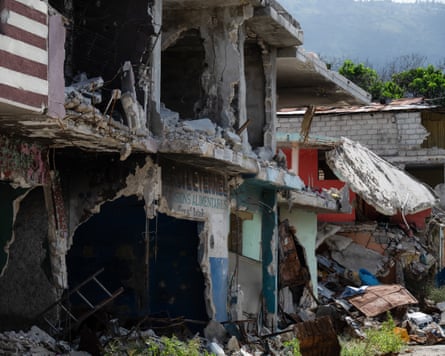
Amid the excitement there is also unease. Some fear Bukele’s offensive could exacerbate an already volatile situation in and around Haiti’s capital, much of which resembles a war zone. This week, there was heavy fighting between Salvadoran troops, police and gangs in Village of God, the shantytown that is Izo’s main base. On Thursday, police said officers had killed at least 34 suspected criminals during an operation near the stadium.
Some suspect El Salvador’s president, a social media whiz with 22 million followers on X and TikTok, could be exaggerating his troops’ role in recent successes with help from a strike team of online propagandists and fans. “Nayib Bukele is gang kryptonite,” one US enthusiast gushed this week, calling his intervention “a miracle”.
Others fret over Bukele’s ability to distinguish between gang members and civilians, given the indiscriminate nature of his mass detention campaign in El Salvador, where thousands of innocent people have been jailed without due process.
Clesca downplayed concerns over the toll Bukele’s crackdown has taken on democracy and the rule of law in El Salvador, which now has the world’s highest per capita incarceration rate. Haitian politics was so contaminated with organised crime, she argued, “it’s almost like the mafia has taken over 10 Downing Street”.
“If you’re talking about [an] assault on democracy, Haiti is … almost a case study that is … even worse, more flagrant, than El Salvador,” Clesca said.
The security situation was so dire that urgent action was needed. “Let’s just be honest … in Haiti, we’re being brutalised,” Clesca said. “Girls are being taken as sexual slaves. They’re being gang raped. So somewhere along the line, we have to say: ‘Haiti helped [South American independence hero] Simón Bolívar [who received shelter and support from Haiti in the early 1800s] … and now, Bukele is helping us’.”
At Tuesday’s rally, protesters spoke of El Salvador’s president in divine terms. “Today, we see Bukele as a saviour, as someone sent by God,” said one man, before adding a word of caution that spoke to countless past interventions that have ended in frustration and failure.
“There is one thing I will say to President Bukele,” he said. “He must not start with us and leave us halfway.”