文化体育
观众们对网飞这部颇具争议的新热门剧集极为着迷。看过之后,我明白了原因。
中文译文
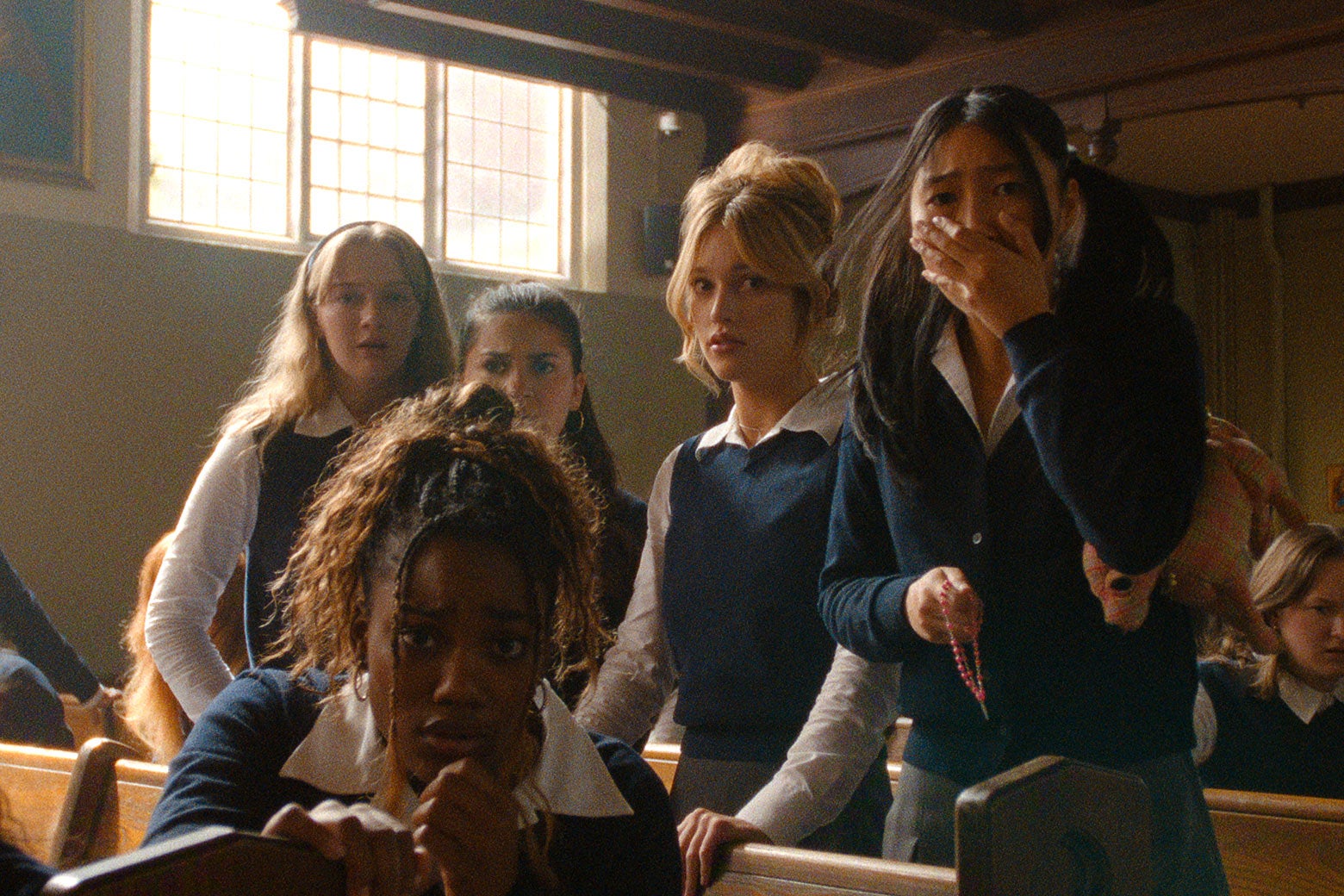
在数字时代伊始,没有比一所充满压抑情绪的少女们的天主教学校更合适的背景,来探讨罪恶感与欲望之间的复杂关系。从Netflix最新热门剧集那句调皮的宣传语——“她们虔诚祈祷,却更肆意犯罪”来看,《The Body》显然深刻理解了这一点。这部共八集的剧集讲述了一群女学生因开玩笑地举行撒旦仪式而引发集体歇斯底里事件后的故事,而它本身也几乎变成了一场集体歇斯底里事件。《The Body》迅速成为Netflix的热门剧集,在网络上广为流传。从该平台大力推广这部剧及其相对不知名的演员来看,它已逐渐成为Netflix的宠儿,有望取得与去年剧集《Heated Rivalry》类似的巨大成功。与此同时,据报道有10万名基督教信徒签署了请愿书,要求Netflix禁止播放这部剧,理由是其传播了关于他们信仰的“亵渎性”观念,并助长了可耻的行为。(一份支持该剧集的联名请愿书已经收集到了超过20,000份签名。)该剧以心理恐怖、女同性恋间的渴望为核心元素,同时在风格和美学上借鉴了千禧年代的少女题材经典作品——比如《贱女孩》、《凯莉》和《詹妮弗的尸体》与《口香糖女孩》的结合,甚至还带有一些1998年恐怖电影《环》的元素——难怪《The Body》能在各个层面都大获成功。在我亲自观看之后,我可以肯定地说我理解它了:《The Body》绝对是今年最出色的剧集之一。这部剧将时间设定在2004年的万圣节,地点是圣马可天主教高中,这所高中坐落在一个小型宗教小镇上。该校的女子舞蹈队“狮子队”正在举行试镜,为受伤的队员寻找替代者。队长兼最受欢迎的女孩安雅(克里斯蒂娜·博吉克)负责监督试镜,而其中显然最有希望入选的是格蕾丝(索菲亚·怀利),她是圣马可高中校长的侄女。按照传统,“狮子队”必须给新成员一个“入门考验”,于是就在那晚的万圣节派对上,这些女孩们开玩笑地表演了一个撒旦仪式,将被迫服用摇头丸的格蕾丝当作处女祭品献上。但当晚格蕾丝陷入昏迷后,这些女孩开始担心自己是否要为她的病情负责——是药物导致的,还是她真的被撒旦附身了?当一名队员谎称自己看到了格蕾丝的幻象后,其他学生也相继声称看到了格蕾丝的影子,局势愈发紧张。不久之后,关于那名处于昏迷状态的女孩拥有所谓超自然力量的传言便在整座小镇上传开。实际上,这种恐慌大多是由莉丝贝丝(吉娜·梅萨罗斯饰)策划的——她是个孤僻的人,既觊觎格蕾丝在团队中的位置,又想与安雅建立更亲密的关系。而安雅则一直在努力接受自己与最好的朋友伊莉丝(萨拉·布斯坦尼饰)之间存在的相互吸引。
此处“身体”一词既指基督的身体——它本身具有多重含义:教会、圣餐,以及耶稣身体遭受亵渎的象征——也指少女的身体及其所承受的一切痛苦,从饮食失调到药物滥用,再到令人沮丧的性经历。尽管这一隐喻有些生硬,但并不显得幼稚。虽然“狮子队”的成员们出于内疚,认为他们所看到的关于格蕾丝的幻象是某种天罚,但仔细分析后会发现,这些异常现象更可能是大量药物使用以及青少年时期多疑心理所导致的心理生理反应。那些为数不多的应对方式——毒品、性行为、宗教的宽恕——只会让这些女孩更加焦虑不安。
创作者奎因·谢泼德所探讨的主题——作为女孩成长过程中的种种压力、性取向觉醒带来的困惑,以及天主教利用罪恶感来控制信徒的行径——在这些关于少女生活的复杂描绘中虽已常见,却依然极具吸引力。即便没有宗教或罪恶感的束缚,少女时期也早已饱受罪恶感的困扰。这是女孩们生命中一切都在变化的阶段,从身体到身份,再到与父母及信仰的关系。这部作品讲述了一个动人的故事,展现了青少年为了逃避不愿面对的真相,会转向那些意想不到的途径来寻求慰藉。不过,《The Body》的出色之处在于,它在探讨所有这些问题的同时,并未牺牲其犀利的幽默感与趣味性。我所喜爱的那些讲述少女成长艰辛的影视作品,往往能以独特的风格与奇思妙想来承载这些沉重主题,而《The Body》在这方面表现得极为出色。剧中充满了富有时代特色的有趣元素:翻盖手机、AOL即时通讯工具的提示音、杰夫·巴克利的音乐片段,以及格蕾丝·凯利·克拉克森的歌曲《Breakaway》的重复旋律,就连节目的标题卡也镶满了珠宝,看起来就像2000年代初Juicy Couture运动服背面的装饰。莉丝贝丝那阴险狡诈的性格,因为她没有眉毛而显得十分滑稽可笑。舞蹈场景虽不多,但十分有趣且充满活力,就连剧中配角(比如扮演狮子队怀孕教练的“叛徒”组合中的加比·温迪)的性格也充满了幽默感。如果存在任何明显的时代错位,那也出在那些男孩身上,比如安雅的男友史蒂文(奥兰多·诺曼),他完全符合2026年的伴侣标准,远非人们想象中2004年那所天主教学校里的运动型男生。不过这也没关系——谢天谢地,这里的主角并非那些男孩。
我们已经很久没有看到出色的高中题材剧集了,更不用说有像《詹妮弗的躯体》那样优秀的续作。这部深受喜爱的电影既聪明又有趣,同时毫不掩饰地展现了当掠夺性的男人遇到年轻女孩时所造成的破坏与愤怒。在当下,当现实中的文化斗争——传统妻子观念!“非自愿单身者”群体!生育权利倒退!——正在对年轻女性(以及男性)的身体和心灵造成严重伤害时,《詹妮弗的躯体》的出现可谓恰逢其时。
原文
There is no better narrative setting for exploring the cross section of guilt and desire than a Catholic school full of repressed teenage girls at the dawn of the digital age. Judging by the cheeky tagline—“They pray hard and sin harder”—of Netflix’s latest hit series, this is something The Body understands. The eight-episode drama, which follows a group of schoolgirls after they jokingly perform a satanic ritual that results in a mass hysteria event, has turned into something of a mass hysteria event itself. The Body swiftly became a Netflix No. 1 show, achieved internet virality, and, judging by how hard the streamer is promoting the series and its relatively unknown stars, has become a Netflix darling approaching the breakout success of last year’s Heated Rivalry. At the same time, a reported 100,000 people of Christian faith have signed a petition demanding that Netflix ban the show for spreading “blasphemous” ideas about their faith and encouraging shameful behaviors. (A counterpetition in support of the series has already garnered over 20,000 signatures.) With its core of psychological horror, sapphic longing, and tonal and aesthetic throwbacks to Y2K-era girlhood classics—think Mean Girls, Carrie, and Jennifer’s Body meet Jawbreaker, Gossip Girl, and even a dash of the 1998 horror film Ring—it’s no wonder The Body has blown up in every way imaginable. And after watching it myself, I can safely say that I get it: The Body is one of the best shows of the year.
The series drops us off in 2004, on Halloween, at St. Mark’s, a Catholic high school nestled in a small religious town where the school’s all-girl dance team, the Lions, is holding auditions to find a replacement for an injured classmate. The head captain and quintessential popular girl, Anya (Kristina Bogic), oversees the auditions, which have a clear front-runner: Grace (Sofia Wylie), the niece of the St. Mark’s headmaster. Following tradition, the Lions have to haze a new member, which is how, at a Halloween party that evening, the girls end up jokingly performing a satanic ritual offering up Grace, whom they’ve pressured to take ecstasy, as a virgin sacrifice. But after Grace falls into a coma later that night, the girls’ paranoia about their complicity in her ailment—was it the drugs, or was she actually possessed by Satan?—puts them on edge. When one teammate falsely claims to have seen a vision of Grace, it sparks a chain of other students experiencing sightings of Grace; soon, rumors about the comatose girl’s so-called spiritual powers begin to take hold over the entire town. In reality, much of the hysteria is orchestrated by Lisbeth (Geena Meszaros), a loner who covets both Grace’s spot on the team and a closer relationship with Anya, who is busy struggling to accept her mutual attraction to her best friend, Elise (Sara Boustany).
Here, the phrase the body serves as a reference to the body of Christ—which already has multiple meanings: the church, Communion, and a reminder of the violation of Jesus’ body—as well as to the body of a teenage girl and all it suffers, from eating disorders to drug use to frustrating sexual experiences. Though heavy-handed, the metaphor doesn’t feel rudimentary. While the Lions, in their guilt, believe that their visions of Grace are some sort of godsent comeuppance, reading between the lines suggests that these anomalies are more easily chalked up to a psychosomatic response to copious drug use and teenage paranoia. The few coping mechanisms—drugs, sex, religious absolution—these girls have only cause them to wig out further.
The themes that creator Quinn Shephard tackles—the tensions of growing up as a girl, of having a queer sexual awakening, and of Catholicism’s weaponizing of guilt to hold power over its disciples—are familiar but irresistible in this complex portrait of girlhood. Guilt already plagues the teenage girl experience even without the weight of religion or sin. It’s a time in girls’ lives when everything is changing, from bodies to identities to relationships with parents and faith. The Body is a poignant story about the unlikely places where the teenage mind will run in order to explain truths it doesn’t want to confront.
What makes The Body so good, though, is that it explores all of this without sacrificing its biting humor or sense of fun. My favorite media about the trials and tribulations of being a teenage girl shoulder those burdens with style and whimsy, both of which The Body has in abundance. There are the charming, era-appropriate references: flip phones, the AOL Instant Messenger notification sounds, Jeff Buckley needle drops and a refrain of Grace’s Kelly Clarkson “Breakaway” ringtone, and even the show’s bejeweled title card, which looks like something you’d see on the backside of an early-aughts Juicy Couture sweatsuit. Lisbeth’s fearsome conniving is undercut by the hilarity of her having no eyebrows. The dance scenes are rare but fun and frenetic, and the personalities of even the show’s background players (like The Traitors’ Gabby Windey, who plays the Lions’ pregnant coach) carry the humor. If there are any glaring anachronisms, they lie with the boys, like Anya’s boyfriend, Steven (Orlando Norman), who is much more up to 2026’s social standards of a significant other than one would expect of a 2004 Catholic schoolboy jock. It’s fine, though—the boys aren’t the stars here, thank God.
It’s been a minute since we’ve had a hit high school drama, and even longer since we’ve been treated to a good follow-up to the likes of Jennifer’s Body, a cult-favorite film that is as smart and funny as it is unapologetically brutal about the devastation and rage that occurs when predatory men meet young girls. In this moment, when the present-day culture wars—tradwives! incels! rollbacks on reproductive rights!—have wreaked havoc on young women’s (and men’s) bodies and minds, The Body couldn’t have come at a better time.